
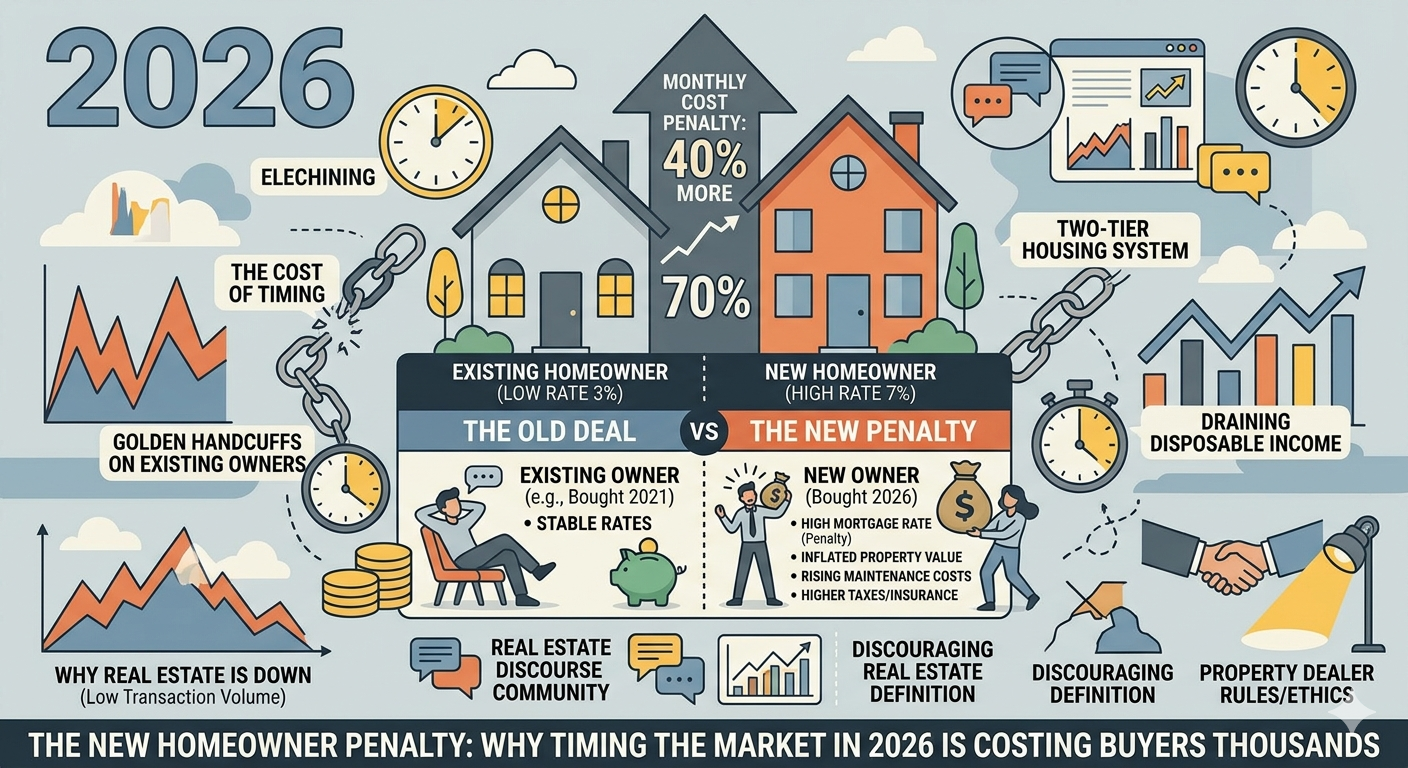
The ‘New Homeowner Penalty’: Why Timing the Market in 2026 is Costing Buyers Thousands
The dream of homeownership has hit a new, complex hurdle in 2026. Financial experts and analysts are now pointing to a phenomenon known as the “New Homeowner Penalty.” This isn’t a formal tax from the government, but rather a combination of high mortgage rates, inflated property values, and the hidden costs of maintenance that specifically punish those entering the market today compared to those who bought just a few years ago.
For anyone following the current real estate discourse community, the conversation has shifted from “how to buy” to “whether it’s even worth it” in the current economic climate.
What is the New Homeowner Penalty?
The “penalty” refers to the massive gap in monthly housing costs between existing homeowners and new buyers. While many current owners are locked into “golden handcuff” mortgage rates of 3% or 4%, new buyers are facing rates nearly double that. This creates a discouraging real estate definition of the market: a two-tier system where new entrants pay significantly more for the exact same square footage as their neighbors.
According to recent data, a new homeowner today might pay up to 40% more in monthly principal and interest than someone who purchased the identical house in 2021. This “penalty” is draining the disposable income of the younger generation and first-time buyers.
Why Real Estate is Down (or Feeling Stuck)
Many investors are asking why real estate is down in terms of transaction volume, even if prices remain high. The answer lies in the lack of “move-up” buyers. People are staying in their current homes because moving would mean giving up their low interest rate and accepting the New Homeowner Penalty.
This has led to a stagnant property discourse where inventory remains at historic lows. Without people moving, there are no houses for sale, which keeps prices artificially high despite lower demand.
The Role of Property Dealer Rules and Market Ethics
In this high-pressure environment, understanding property dealer rules and ethical standards is more important than ever. With fewer houses on the market, some agents are pushing for bidding wars or skipping inspections to close deals quickly.
Prospective buyers are looking for any relief they can find, often searching for a real estate discount offer or government grants. However, in most “hot” markets, these discounts are rare, and the “penalty” of high entry costs remains the dominant factor.
Maintenance and “The Hidden Penalty”
Beyond the mortgage, the penalty includes the rising cost of home services. From insurance premiums to property taxes and contractor fees, the cost of maintaining a home has outpaced inflation. New homeowners, who are already stretched thin by their mortgage payments, often find themselves “house poor” within the first six months.
The real estate discourse community on platforms like Reddit and LinkedIn is full of stories from new buyers who underestimated the “carrying costs” of their property, leading to a sense of buyer’s remorse that is cooling the market.
Can You Avoid the Penalty?
Is there a way to sidestep the New Homeowner Penalty? Experts suggest a few strategies:
- Adjustable-Rate Mortgages (ARMs): Some are betting that rates will fall in the next 3-5 years, using ARMs to lower initial costs.
- Buying Points: Paying more upfront to lower the interest rate, though this requires significant cash on hand.
- The “Wait and See” Approach: Many are choosing to remain in the rental market, waiting for a significant real estate discount offer or a market correction.
Conclusion
The “New Homeowner Penalty” is a stark reminder that in real estate, timing is everything. For the 2026 buyer, the cost of entry has never been higher, not just in price, but in the long-term financial burden compared to previous generations. As the property discourse continues to evolve, the focus will likely remain on affordability and the search for policy changes that can level the playing field for the next generation of owners.
Frequently Asked Questions (FAQs)
1. Is the New Homeowner Penalty an actual government fee?
No. It is a term used by economists to describe the higher cost of homeownership for new buyers today compared to those who bought when interest rates were much lower.
2. Why is real estate inventory so low right now?
Inventory is low because existing homeowners don’t want to sell their houses and lose their current low-interest mortgage rates—a phenomenon called the “lock-in effect.”
3. What is a “real estate discourse community”?
It refers to the group of professionals, investors, and enthusiasts who regularly discuss and analyze market trends, ethics, and news through blogs, forums, and social media.
4. How can I lower my “penalty” as a first-time buyer?
You can look for “seller concessions” where the seller pays for a mortgage rate buy-down, or search for specialized first-time buyer programs in your local area.
5. Are property dealer rules changing in 2026?
While core laws remain, there is increasing pressure for transparency in commission structures and more stringent rules regarding “dual agency” to protect buyers in a high-cost market.