
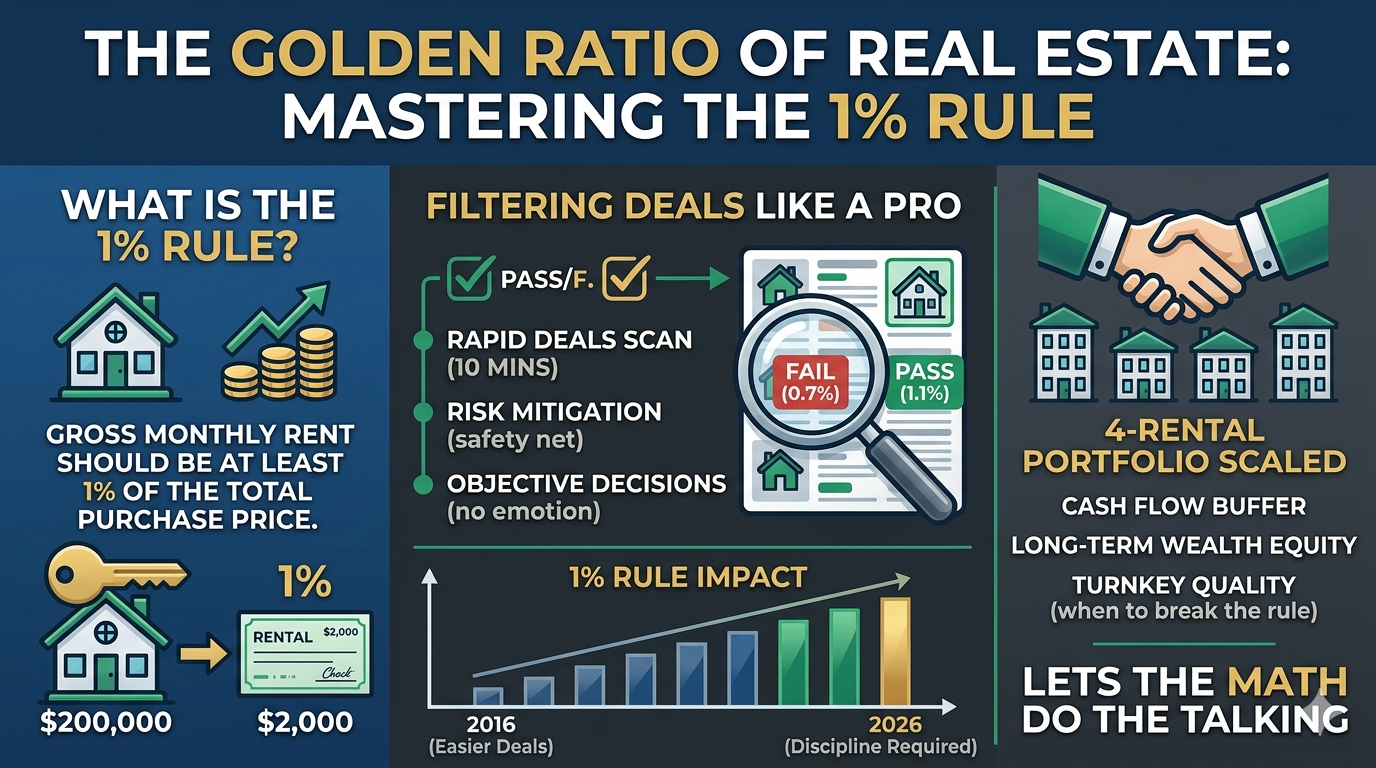
The Golden Ratio of Real Estate: How a Pro Uses the 1% Rule to Scale a 4-Rental Portfolio
In the high-stakes world of real estate investing, the difference between a “money pit” and a “cash cow” often comes down to a single, simple calculation. For one seasoned investor who has successfully built a portfolio of four profitable rental properties, the secret weapon isn’t a complex algorithm or insider trading—it’s the 1% Rule.
As property prices fluctuate and interest rates remain a primary concern for buyers in 2026, this foundational rule of thumb is more relevant than ever. It provides a quick “litmus test” to determine if a property is worth a deep dive or if it should be discarded immediately.
What is the 1% Rule?
At its core, the 1% Rule states that a rental property should bring in at least 1% of its total purchase price in gross monthly rent.
For example, if you are looking at a property priced at $200,000, the 1% Rule dictates that it should generate at least $2,000 per month in rent.
This calculation is designed to ensure that the gross income covers the mortgage, taxes, insurance, and maintenance costs, while still leaving a “buffer” for profit (cash flow). If a property can’t hit this mark, the investor argues, it is likely that the owner will end up “subsidizing” the tenant’s lifestyle out of their own pocket every month.
Why the 1% Rule Matters in 2026
With the real estate market seeing sustained growth, finding 1% deals has become significantly harder than it was a decade ago. However, the investor explains that this is exactly why the rule is so vital today. It acts as a discipline mechanism.
- Risk Mitigation: By sticking to the 1% Rule, you build in an automatic safety net for unexpected repairs or vacancies.
- Rapid Filtering: Real estate sites are flooded with listings. The 1% Rule allows you to scan 50 properties in 10 minutes, narrowing them down to the 2 or 3 that actually make financial sense.
- Objective Decision Making: It removes the “emotional” aspect of buying. You stop looking at the beautiful crown molding or the “charming” neighborhood and start looking at the numbers.
How to Apply the Rule: Beyond the Sticker Price
The investor emphasizes that “purchase price” isn’t just the number on the contract. To truly follow the 1% Rule, you must include upfront repair costs.
The Formula: (Purchase Price + Immediate Renovations) x 0.01 = Minimum Monthly Rent
If you buy a fixer-upper for $150,000 but need to spend $50,000 on a new roof and flooring, your total investment is $200,000. Under the 1% Rule, that property needs to rent for $2,000, not $1,500.
Limitations: When to Break the Rule
While the 1% Rule is a powerful starting point, the investor notes two specific scenarios where he might settle for a 0.8% or 0.9% return:
- High-Appreciation Markets: In “A-Class” neighborhoods where property values are skyrocketing, you might accept lower monthly cash flow in exchange for massive long-term wealth through equity growth.
- Turnkey Quality: If a property is brand new and requires zero maintenance for the next decade, the lower “expense ratio” might justify a slightly lower rent-to-price ratio.
Conclusion: The Path to Four Rentals
Building a portfolio of four properties wasn’t about finding “perfect” houses; it was about finding “perfect” numbers. By using the 1% Rule as a non-negotiable filter, this investor has ensured that every addition to his portfolio adds to his monthly income rather than draining his savings. For aspiring investors in 2026, the message is clear: Let the math do the talking.
Frequently Asked Questions (FAQs)
1. Is the 1% Rule still realistic in today’s expensive market?
It is challenging but possible. Investors often find these deals by looking at emerging “B-Class” neighborhoods, seeking out-of-state opportunities, or finding off-market deals where the seller is motivated to move quickly.
2. Does the 1% Rule include utilities?
No. The 1% Rule generally refers to Gross Monthly Rent. Utilities, property management fees, and taxes are expenses that should be paid out of that 1% “pot.”
3. What if a property only hits 0.7%?
For many strict cash-flow investors, a 0.7% property is a “pass.” In a high-interest-rate environment, a 0.7% return often results in “negative cash flow” once you factor in the mortgage and maintenance.
4. How do I find out what a house will rent for?
Investors use “Rent Comps” (comparables). Tools like Zillow, Rentometer, or talking to local property managers can give you a realistic idea of what tenants are currently paying in that specific zip code.
5. Does the 1% Rule apply to multi-family units?
Yes, and it’s often easier to hit the 1% mark with multi-family properties (duplexes or triplexes) because you have multiple “doors” generating income for a single purchase price.