
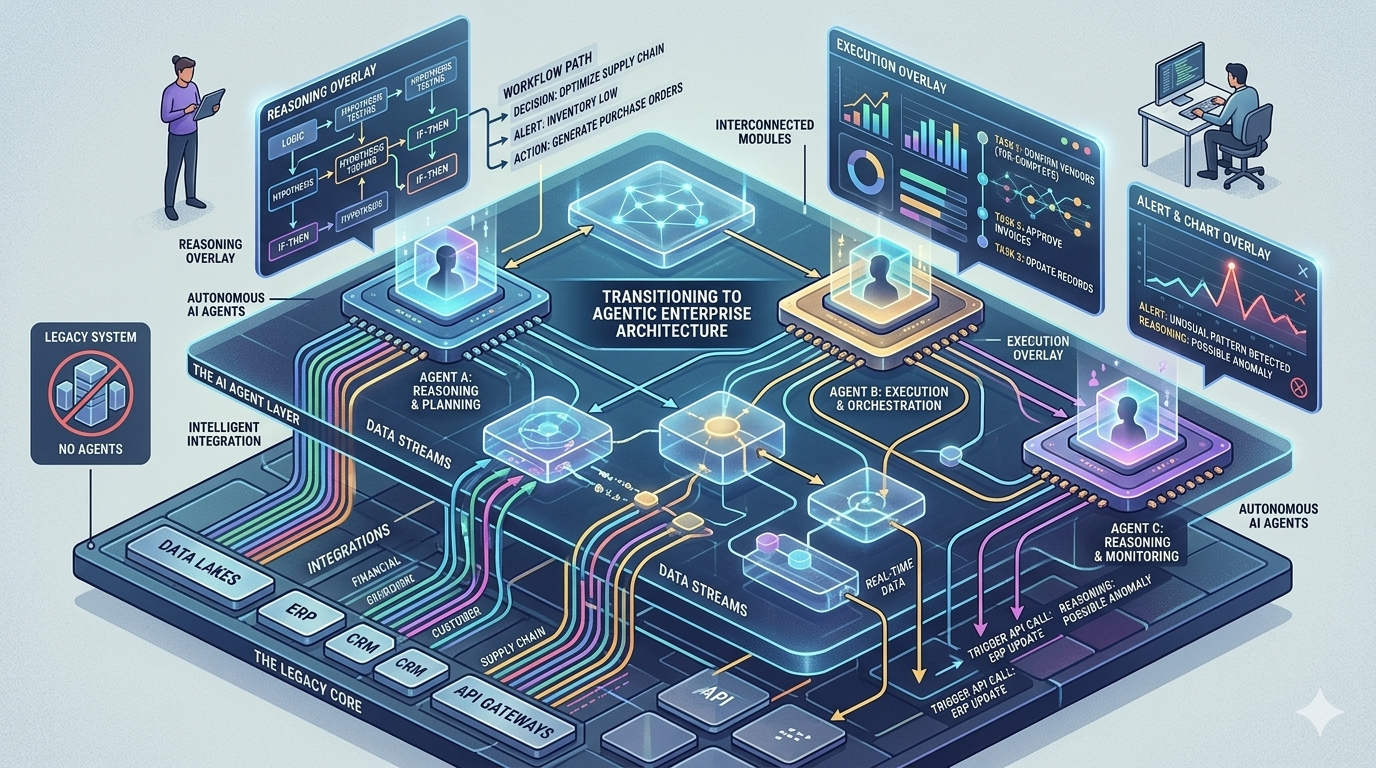
Why Agentic AI Demands a New Architecture
Artificial intelligence is evolving rapidly, and a new generation of AI systems — known as agentic AI — is pushing the technology beyond simple tools toward autonomous systems capable of reasoning, planning, and executing complex tasks on their own. Unlike traditional AI, which responds to direct commands, agentic AI can interpret its environment, make decisions, and take actions across multiple systems without constant human input.
This shift has profound implications for how organizations build and manage their software infrastructure. Legacy software architectures — designed around predictable workflows and human‑initiated actions — are increasingly unable to support the dynamic, autonomous behavior required by agentic systems. As a result, enterprises must rethink the foundational design of their technology stacks to unlock the full potential of these advanced AI agents.
What Makes Agentic AI Different
Traditional AI systems generally work by taking an input — such as a user query or dataset — and producing an output. They do not persist beyond that interaction, and they do not adapt on their own. In contrast, agentic AI systems are designed to:
- Reason about context: Understand both historical and real‑time information to make decisions.
- Coordinate tasks: Plan and execute sequences of actions, often involving multiple systems.
- Adapt over time: Learn from new data and adjust strategies without explicit re‑programming.
These capabilities make agentic AI especially powerful for solving complex, real‑world problems that span multiple domains and data sources.
Why Legacy Architectures Fall Short
Most enterprise systems were built for a world where human users drive workflows and decisions. They typically rely on:
- Rigid, sequential processes
- Siloed data stores that are updated in batches
- Interfaces designed for human interaction
- Security models based on direct oversight
Such designs limit how effectively agentic systems can operate. Agentic AI requires real‑time data access, seamless connectivity between systems, and the ability to take actions without human intervention. When data is stored in separate silos or workflows cannot be adapted dynamically, AI agents struggle to perform even moderately complex tasks.
The New Architectural Imperatives
To support agentic AI, organizations must embrace modern architectural principles that enable autonomy, coordination, and control. The most important elements include:
1. Real‑Time Data Access
Agentic systems must be able to retrieve and act on data instantly. Slow or batch‑based data pipelines create bottlenecks that hinder decision‑making.
2. Modular, Interconnected Platforms
Rather than rigid, monolithic systems, architectures need to be modular. Components should be loosely coupled and able to communicate with each other via secure APIs or messaging layers.
3. Orchestration and Coordination
Agentic AI systems often act like project managers: they plan workflows, assign tasks, and track progress. This requires a mesh of systems that can talk to one another, surface status, and report outcomes in real time.
4. Governance, Security, and Compliance
As AI takes on more responsibility, organizations must ensure that decision paths are transparent, auditable, and compliant with regulatory standards. This means building in monitoring, safety checks, and mechanisms to intervene when needed.
The Human and Organizational Dimension
The rise of agentic AI is not only an engineering challenge but also an organizational one. As autonomous systems take on complex tasks, human roles may shift toward governance, oversight, and strategic orchestration. Teams will need to think differently about workflows, ownership, and accountability.
Rather than replacing humans, agentic AI can augment human capabilities — freeing people from repetitive tasks and enabling them to focus on higher‑value decision‑making. To achieve this, companies must invest in both technology and people, creating training programs and cross‑functional teams that understand AI systems deeply.
Conclusion
Agentic AI is reshaping expectations about what intelligent systems can do. Unlike traditional AI, which simply reacts to inputs, agentic systems can reason, plan, and act autonomously. To support these capabilities, enterprises must move beyond legacy architectures built for predictable, human‑driven processes and embrace modern, interconnected, and flexible systems.
Organizations that adopt new architectural patterns, invest in real‑time data infrastructure, and develop governance frameworks will be best positioned to capture the full value of agentic AI. Those that delay risk falling behind competitors who embrace the transformation required to thrive in an AI‑driven world.
FAQ
1. What is agentic AI?
Agentic AI refers to autonomous artificial intelligence systems that can reason, plan, and carry out tasks without direct human input.
2. How does agentic AI differ from traditional AI?
Traditional AI responds to specific user requests but does not adapt or operate independently. Agentic AI can make decisions and execute actions across systems based on context and goals.
3. Why can’t legacy architectures support agentic AI?
Legacy systems were built for predictable human workflows and lack real‑time data access, modularity, and interconnected processes needed for AI to operate autonomously.
4. What are the key architectural changes needed?
Modern architectures for agentic AI require real‑time data access, modular components, orchestration layers, and strong governance and compliance mechanisms.
5. How will agentic AI impact human roles in organizations?
Instead of replacing humans, agentic AI will shift human roles toward oversight, governance, and high‑level decision‑making, allowing people to focus on strategic tasks.