The $25-Per-Image Era Is Over: How AI Is Disrupting the E-Commerce Photography Pipeline
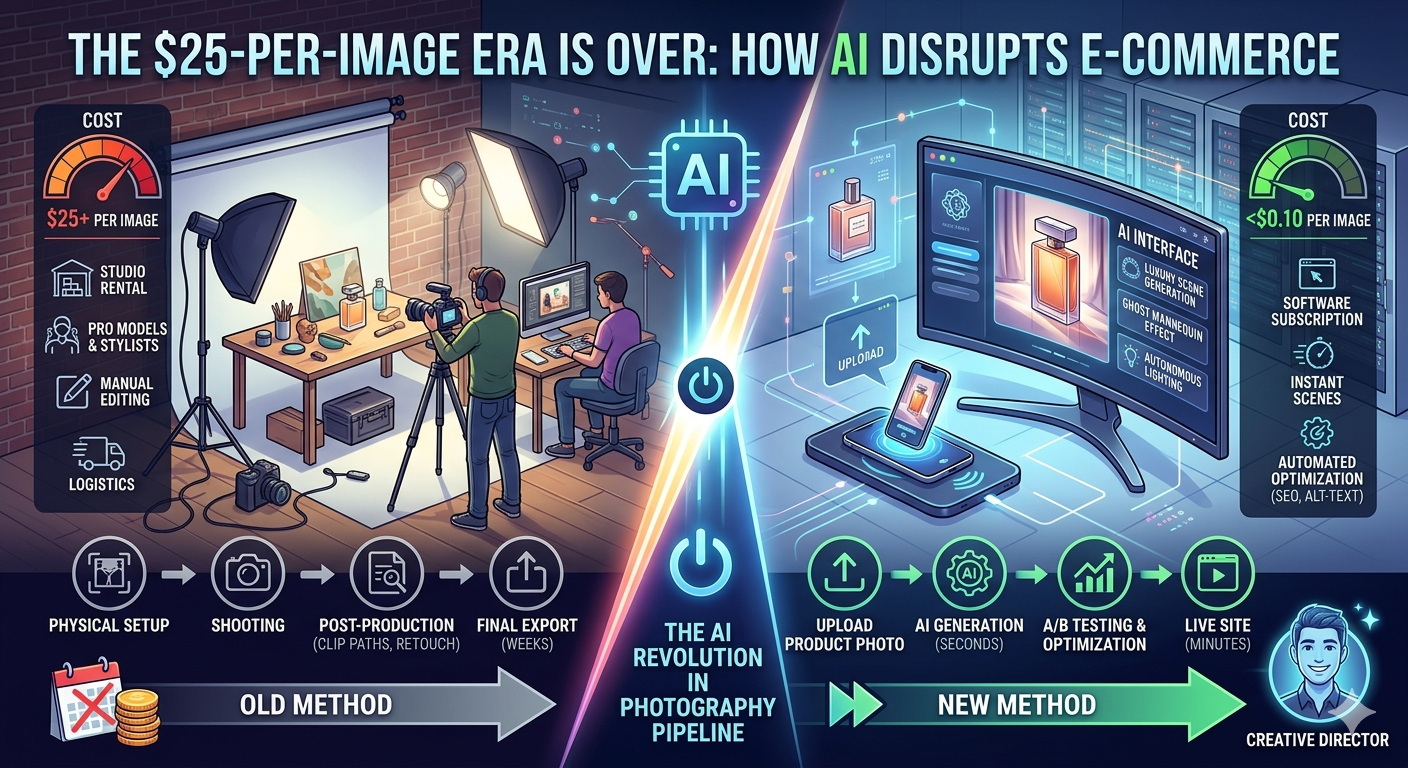
For decades, e-commerce businesses—from small fragrance boutiques to global retail giants—have been tethered to a costly and slow-moving photography pipeline. A single high-quality product shot could easily cost $25 to $50 after factoring in studio rentals, professional photographers, props, and extensive post-production. However, a seismic shift is occurring in 2026. The traditional studio model is being dismantled by specialized AI platforms capable of generating hyper-realistic product imagery at a fraction of the cost and time.
This transition marks the end of the “per-image” billing era and the beginning of an automated, AI-driven creative workflow.
The Death of the Traditional Studio Model
The traditional e-commerce photography process is notoriously rigid. It requires shipping physical products to a studio, setting up lighting rigs, and hiring editors to manually remove backgrounds or fix reflections. This process often takes weeks from concept to final export.
New AI technology, specifically AI Ghost Mannequin and Product Scene Generation, has turned this weeks-long process into a seconds-long task. By uploading a simple smartphone photo of a product, businesses can now:
- Place products in luxury, high-end environments (e.g., a perfume bottle on a marble vanity in a sunlit Parisian apartment).
- Use AI models to “wear” clothing items without hiring human talent.
- Instantly resize and optimize images for website sliders, banners, and mobile-first social media feeds.
Why the $25 Fee is Vanishing
The cost of $25 per image was primarily driven by labor and overhead. AI platforms operate on a SaaS (Software as a Service) model, where a monthly subscription might allow for thousands of generations. This brings the effective cost per image down from double digits to mere cents.
For industries like the fragrance and luxury goods market, where visual “vibe” and “elegance” are everything, this is a game-changer. Instead of one static shot, a brand can now generate 50 different lifestyle scenes for the cost of a single cup of coffee, allowing for rapid A/B testing on ads and social media.
The Integration of AI and Human Creativity
While the “pipeline” is being replaced, the need for human direction remains. Professional photo editors and brand managers are shifting their roles from manual labor (like clipping paths) to “Creative Direction.” They now use AI to iterate on complex brand aesthetics—such as shifting from a “minimalist” look to a “luxury gift” theme—with a few text prompts rather than a total reshoot.
This shift is particularly evident in the rise of AI chatbot interfaces that allow users to describe a scene and see it materialize instantly, effectively acting as an automated digital studio.
Frequently Asked Questions (FAQs)
Q1: What does “AI Ghost Mannequin” technology mean? This is a specialized AI process used in fashion e-commerce. It allows a brand to take a photo of a garment on a mannequin and use AI to “hollow out” the mannequin, making the clothes look like they are being worn by an invisible person. This provides a 3D, high-end look without the cost of a model or complex editing.
Q2: Will AI images look “fake” to customers? In 2026, AI-generated photography has reached “photorealism parity.” Using advanced diffusion models, AI can now replicate the exact physics of light, shadows, and reflections on glass or liquid (like perfume oils), making it nearly impossible for the human eye to distinguish from a traditional photograph.
Q3: How does this help with SEO and website performance? AI platforms don’t just create images; they optimize them. They can automatically generate alt-text, SEO-friendly file names, and export images in modern formats (like WebP) that maintain high quality while ensuring fast page load speeds—critical for ranking on search engines.
Q4: Can I use AI to create marketing images with celebrities? While AI can generate human-like models, using the likeness of specific celebrities requires legal licensing. However, many brands use AI to create “brand-consistent” models that represent their target demographic perfectly without the recurring costs of talent contracts.
Q5: Is it difficult to switch from a professional photographer to an AI platform? Most modern platforms are designed with “no-code” interfaces. If you can describe a scene (e.g., “A luxury oud perfume bottle on a wooden table with soft golden hour lighting”), the AI can generate the image. The learning curve is minimal compared to learning professional lighting or Photoshop.
Q6: What happens to professional product photographers? The industry is evolving. Many photographers are now becoming “AI Artists” or “Creative Technologists,” using their eye for composition and lighting to prompt AI tools more effectively than a layperson could.
Q7: How do I remove my old subscription and move to AI? Most AI photography platforms offer free trials. Businesses are encouraged to run a side-by-side test: compare the engagement of a $25 studio shot versus a $0.10 AI-generated shot. Most find that the AI shot performs just as well, if not better, due to the ability to customize the background for specific holidays or sales events.