
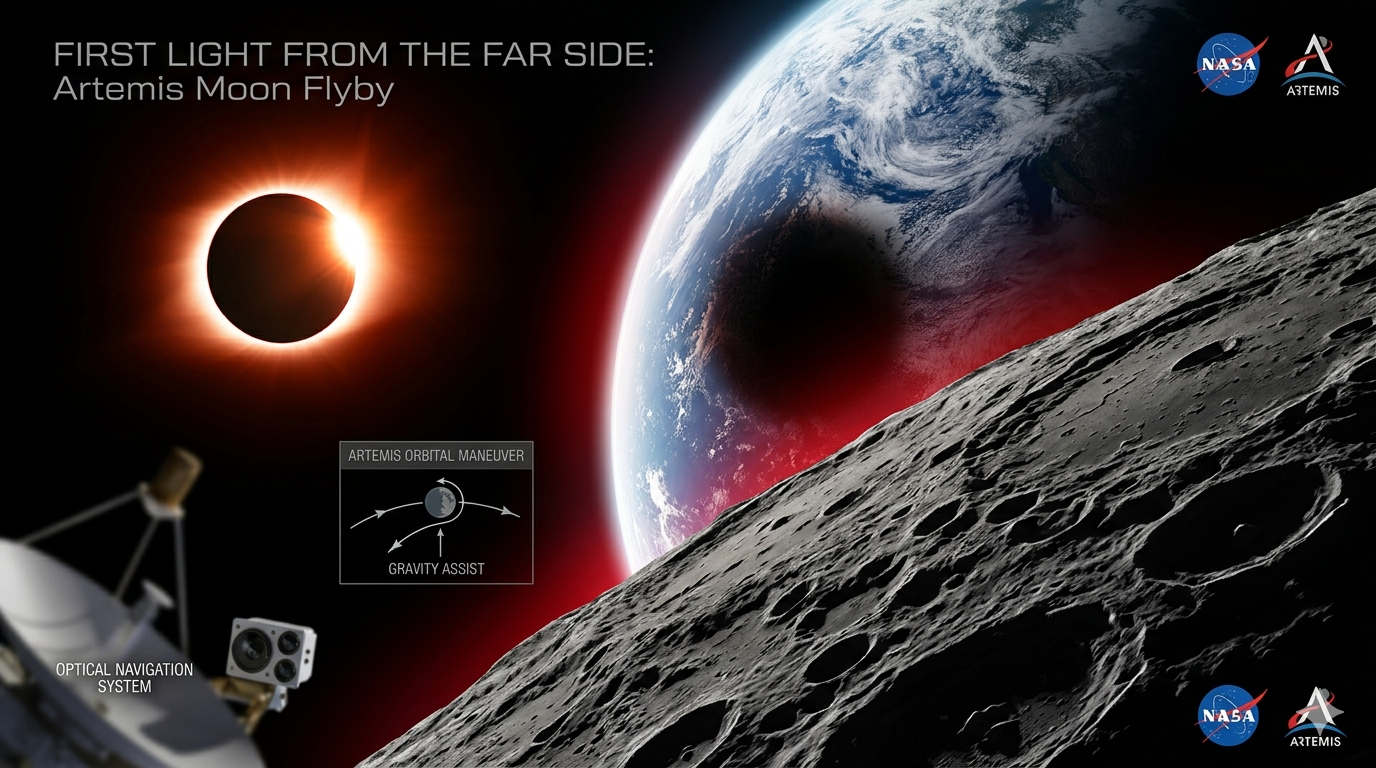
First Light from the Far Side: NASA’s Artemis Flyby Captures Earth-Set and Lunar Eclipse
In a historic moment for space exploration, NASA has released the first batch of high-resolution photographs from its latest Artemis moon flyby. These images, captured as the spacecraft swung around the lunar far side, provide a perspective of our home planet and its celestial neighbor that has not been seen with such clarity since the Apollo era.
The mission, a critical stepping stone for returning humans to the lunar surface, has yielded more than just technical data. It has provided a profound visual reminder of Earth’s fragility, featuring a breathtaking “Earth-set” and a rare view of a solar eclipse from the moon’s perspective.
The “Earth-Set”: A Marble in the Dark
One of the most striking images in the collection shows the Earth slowly dipping below the craggy, cratered horizon of the Moon. Unlike the vibrant, blue-and-white marble we are used to seeing in satellite imagery, this “Earth-set” portrays the planet as a lonely outpost of life against the infinite, velvet blackness of the void.
The detail captured by the Artemis cameras is unprecedented. Viewers can make out the swirl of a massive storm system over the Pacific Ocean and the distinct glint of the sun reflecting off the Earth’s atmosphere. For the engineers at NASA, this photo isn’t just art; it’s a testament to the precision of the spacecraft’s navigation and the high-performance imaging hardware designed to withstand the harsh radiation of deep space.
A Solar Eclipse from the Lunar Perspective
Perhaps the most scientifically significant photo in the release is the documentation of a solar eclipse. While observers on Earth saw the moon pass in front of the sun, the Artemis spacecraft was positioned to see the Earth’s shadow—the umbra—sweeping across the lunar surface.
From the spacecraft’s vantage point, the Earth appeared as a dark disk rimmed by a fiery red ring. This ring, known as the “Limb of the Earth,” is caused by the planet’s atmosphere refracting sunlight. This perspective allows scientists to study the Earth’s atmospheric composition in new ways, using the sun as a backlighting tool to analyze the gases and particles suspended in our air.
The Technical Triumph of the Flyby
The flyby itself was a complex orbital maneuver. To get these shots, the spacecraft had to perform a “Gravity Assist,” using the Moon’s gravitational pull to slingshot itself into a higher orbit. During this period, the spacecraft spent several hours in “radio silence” as it passed behind the lunar far side, cut off from direct communication with Deep Space Network stations on Earth.
The cameras used for these photos are part of a sophisticated optical navigation system. By taking high-frequency photos of the lunar surface and Earth, the spacecraft’s onboard computer can calculate its exact position in space without relying solely on ground-based tracking. This autonomy is crucial for future missions to Mars and beyond.
Finding Our Place in the Cosmos
The release of these photos has sparked a global wave of awe. As we move closer to the 2026 goal of landing the first woman and the next man on the lunar South Pole, these images serve to build momentum and public interest. They bridge the gap between complex science and human emotion, reminding us that exploration is as much about the journey as it is about the destination.
In the words of NASA’s lead mission scientists, these photos “capture the humanity in the loneliness of space.” They show us that while we are small, our reach is vast, and our curiosity is boundless.
Frequently Asked Questions (FAQs)
Q1: Why is it called an “Earth-set” if the Earth doesn’t move around the moon?
Strictly speaking, from the moon’s surface, the Earth usually stays in the same spot in the sky. However, from a spacecraft in orbit, the Earth appears to rise and set over the lunar horizon just as the Sun does for us.
Q2: Why does the Earth look like it has a red ring during an eclipse in space? This is caused by Rayleigh scattering. As sunlight passes through the Earth’s atmosphere, the blue light is scattered away, and only the longer red wavelengths pass through. It is essentially every sunrise and sunset on Earth happening at the same time.
Q3: How do the cameras survive the extreme cold and radiation of space?
Spacecraft cameras are built with specialized “rad-hard” (radiation-hardened) electronics and thermal blankets. They also have internal heaters to keep the delicate glass and sensors at a stable temperature.
Q4: Is the Artemis spacecraft currently manned?
The recent flyby was an uncrewed test flight (or a mission involving robotic scouts) designed to ensure that all systems, including life support and heat shields, are safe before human astronauts are put on board for the next phase.
Q5: When will humans finally land on the moon again?
Under the current Artemis schedule, NASA aims to return humans to the lunar surface by late 2026, targeting the resource-rich South Pole region.