
AI’s Next Act Is Financial Decision-Making
Artificial intelligence (AI) is rapidly moving beyond simple automation and into the core of financial decision-making. In 2026, AI is no longer just assisting with repetitive tasks — it is actively shaping how money moves, how risk is assessed, and how financial decisions are executed across industries. Experts agree that AI’s role in finance is now central, and its influence continues to grow.
From Support Tools to Financial Decision-Makers
Historically, AI in finance focused on improving efficiency: automating data entry, reconciling transactions, and flagging anomalies for human review. Today, AI systems go much further, making decisions on approving refunds, assessing credit, allocating capital, and managing transactions in real time. This evolution has transformed AI from a supportive tool into a primary actor in financial ecosystems.
For example, many retail platforms now use AI to decide whether a customer return should be approved. Some systems automatically process refunds before the returned product even reaches the warehouse. While this creates convenience for consumers, it also introduces risks, as fraudsters attempt to exploit automated systems using fake receipts or doctored documents.
AI Across Industries
AI-driven financial decision-making extends far beyond retail. Energy markets, legal finance, and investment management are also adopting AI systems to make real-time decisions. In energy trading, AI can price, match, and settle complex trades, including carbon credit transactions, with minimal human intervention. Similarly, legal finance firms use AI to forecast settlement amounts and evaluate case funding opportunities, analyzing large datasets to make decisions that once required hours of manual research.
How AI Makes Financial Decisions
At the core of AI financial systems are machine learning algorithms and advanced data analytics tools. These systems are capable of:
- Processing vast volumes of data, far beyond human capacity
- Recognizing patterns and anomalies in complex datasets
- Predicting future conditions using historical and real-time information
- Executing financial decisions automatically based on predefined rules or goals
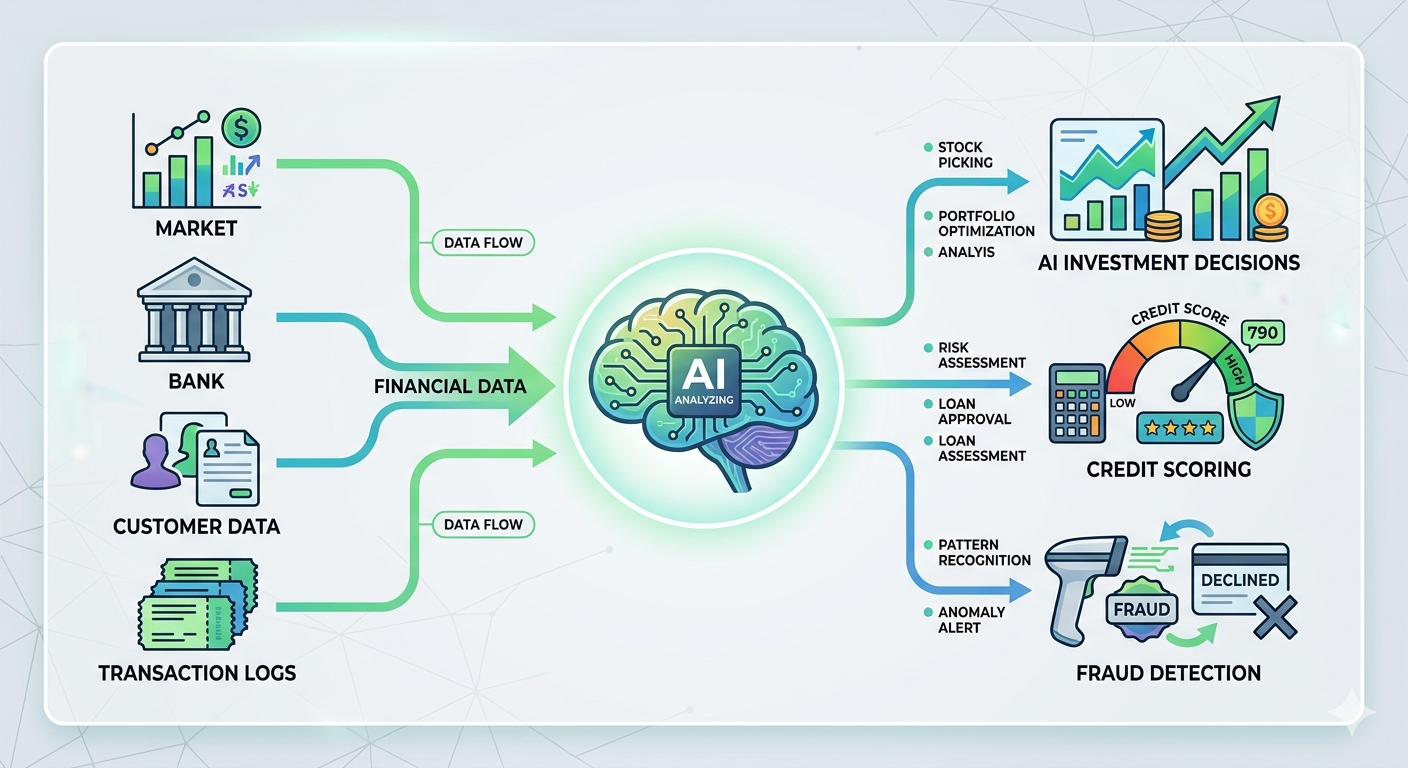
This means AI doesn’t just provide insights — it actively determines outcomes, from investment portfolio adjustments to credit risk evaluation and dynamic pricing strategies. Some systems even forecast cash flow needs and allocate resources without human intervention.
Benefits of AI in Financial Decision-Making
AI offers several advantages in financial workflows:
1. Speed and Efficiency
Decisions that used to take teams of analysts hours or days can now happen in real time. Automated systems accelerate processes like transaction approval, credit scoring, and liquidity assessment.
2. Enhanced Data Insights
AI can process unstructured data such as text, images, and streaming feeds to identify subtle trends and correlations that humans might miss. This improves predictive accuracy and decision quality.
3. Reduced Human Error
Automation of repetitive and complex tasks reduces the likelihood of mistakes, especially in calculations and data-intensive analyses.
4. Scalability
AI can handle workloads that would overwhelm human teams, from evaluating thousands of loan applications to optimizing investment portfolios for millions of customers simultaneously.
Challenges and Risks
Despite its advantages, AI in financial decision-making comes with challenges:
1. Lack of Transparency
Many AI models, particularly deep learning systems, operate as “black boxes,� making it difficult to explain how they reach decisions. This is a concern for compliance, auditing, and user trust.
2. Bias and Fairness
If AI is trained on biased data, it may make biased financial decisions, such as in loan approvals or credit scoring. Ensuring fairness and equity is a major challenge.
3. Regulatory Oversight
Financial regulators are still adapting frameworks to address AI-driven decisions. Companies must navigate inconsistent rules across regions while ensuring compliance.
4. Need for Human Oversight
Even highly autonomous AI systems require human monitoring, especially for high-stakes or ethically sensitive decisions. Balancing automation with human judgment is critical.
The Future of AI in Finance
Looking ahead, AI is expected to take on even more responsibility in financial ecosystems:
- Autonomous AI Systems are emerging that can monitor, plan, and act independently in financial operations, transforming back-office processes into real-time engines.
- Explainable AI (XAI) is gaining focus, allowing institutions to understand and justify AI decisions for regulatory compliance and stakeholder trust.
- Strategic AI Applications are being used for forecasting, budgeting, and risk management, helping finance leaders make faster and more informed decisions.
FAQs About AI in Financial Decision-Making
Q1: What kinds of decisions can AI make in finance?
AI can approve refunds, evaluate credit risk, adjust investment portfolios, detect fraud, and manage settlement processes, often in real time.
Q2: Are humans still necessary?
Yes. Humans provide oversight, ethical judgment, and handle complex cases where AI alone cannot reliably make decisions.
Q3: Can AI be trusted with financial decisions?
With proper governance, monitoring, and transparency, AI can reliably support or even make many financial decisions, but oversight is essential to prevent errors or bias.
Q4: Is AI replacing financial professionals?
AI reshapes roles rather than fully replacing them. It automates repetitive and data-heavy tasks while professionals focus on strategy, ethics, and critical judgment.